
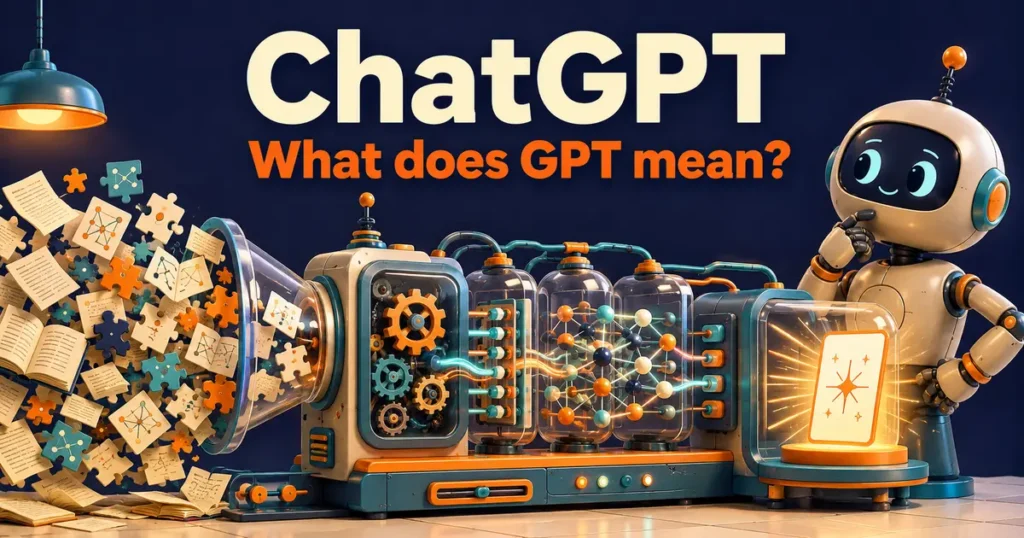
Quick answer: GPT stands for Generative Pre-trained Transformer. That sounds impressive, but can you identify it among four suspiciously believable alternatives? Take the quiz before scrolling any further.
You have probably typed a question into ChatGPT, asked it to rewrite an email or watched it produce a surprisingly confident recipe from three forgotten ingredients. But what does GPT mean in ChatGPT? Be honest: did you ever stop to ask?
The “Chat” part is friendly and obvious. The “GPT” part sounds like a secret department in a science-fiction government. Let us see whether you can decode it.
Quiz: what does GPT really stand for?
Choose one answer for each question. The alternatives are designed to sound plausible, so no peeking.
Show the quiz answers
1: Generative Pre-trained Transformer. 2: It generates output by predicting what comes next. 3: A neural-network architecture based on attention. 4: The Transformer paper came first.
What does GPT mean in ChatGPT?
GPT means Generative Pre-trained Transformer. Each word describes a different part of how this family of language models works. The name is technical, but the basic idea is easier than it looks.
G is for Generative
“Generative” means the model produces an output rather than simply retrieving a pre-written answer from a database. Given a prompt, it generates a continuation one small unit of text at a time. Those units are called tokens: they may be whole words, parts of words, punctuation marks or other common character sequences.
This does not mean the model has a tiny novelist living inside it. It calculates likely continuations from patterns learned during training. That ability can support explanations, summaries, dialogue, translations, code and creative writing. It can also produce mistakes, which is why “generative” must never be confused with “guaranteed”.
P is for Pre-trained
“Pre-trained” means the model learns broad language patterns before you begin your conversation with it. During this stage, it encounters a large amount of material and practises predicting what comes next. It learns relationships between words, structures, styles and ideas through that prediction task.
Later training can make a model more useful in conversation and better at following human instructions. In other words, pre-training gives it broad language capability; subsequent work helps turn that capability into a practical assistant.
T is for Transformer
A Transformer is the neural-network architecture behind GPT. Its defining idea is attention: a mechanism that helps the model consider relationships between different parts of a sequence when processing language.
Imagine the sentence, “The teacher put the book on the table because it was heavy.” To interpret “it”, you need to connect the pronoun to other words. Attention helps a model weigh such relationships across the text. The real mathematics is far more complex, but the useful mental picture is simple: a Transformer looks at context, not merely at one isolated word.
The hidden clue in the image: information enters, relationships are processed and a new response emerges. That visually hints at pre-training, transformation and generation without spelling out the answer.
So what does “Chat” add to GPT?
“Chat” describes the conversational experience built around a GPT model. ChatGPT can follow a dialogue, use earlier turns as context and respond to follow-up questions. The name therefore combines the interface — chat — with the model family behind it — GPT.
ChatGPT is not simply a synonym for every GPT model. GPT refers to a family of generative pre-trained Transformer models, while ChatGPT is the conversational product through which many people use OpenAI’s models.
A short history: from attention to ChatGPT
2017: the Transformer arrives
In 2017, researchers introduced the Transformer architecture in the paper “Attention Is All You Need”. The architecture made attention central and became enormously influential in modern language AI.
2018: generative pre-training proves its value
In June 2018, OpenAI published research on improving language understanding through generative pre-training. The work showed that a model could first learn broadly from unlabelled text and then be adapted to a variety of language tasks. This model later became commonly known as GPT-1.
2019 and 2020: GPT grows
GPT-2, introduced in 2019, scaled the approach and demonstrated stronger text generation. GPT-3 followed in 2020 with a much larger model and striking “few-shot” abilities: it could often perform tasks after being shown only instructions or a handful of examples.
2022: the chat changes everything
OpenAI released ChatGPT as a research preview on 30 November 2022. Its conversational format made language-model technology far easier for the public to explore. Rather than writing code or using a specialist interface, people could simply talk to it.
That approachable “Chat” may explain why the product name became famous while the words behind “GPT” remained mysterious. According to the official OpenAI documentation, GPT models are generative pre-trained Transformers trained to understand natural and formal language and produce text outputs from prompts.
What GPT does — and what the name does not promise
The acronym explains the model’s broad design, not a promise of intelligence, truth or consciousness. A GPT model can produce fluent text because it has learnt powerful statistical relationships in language. Fluency can be extremely useful, but a fluent answer may still be incomplete, outdated or wrong.
Use AI as a capable assistant, not as an infallible oracle. Check important claims, use primary sources and apply professional judgement — especially for medical, legal, financial or safety-critical decisions.
Why the words behind GPT are useful English vocabulary
Technology creates new language quickly, and understanding it makes articles, meetings and workplace conversations easier. The three terms also appear beyond AI:
- Generative describes something capable of producing or creating.
- Pre-trained means trained beforehand, before a later task or stage.
- Transformer usually means something that changes one form into another; in AI, it names a particular architecture.
If English technology vocabulary feels like alphabet soup, start by noticing how technical words are assembled. Prefixes such as pre- often carry a predictable meaning. Building this kind of word awareness is one of the practical strategies covered in our guide to English learning methods.
Teachers can also explore our earlier discussion, Is ChatGPT a Valuable Tool for Language Teachers?, which looks at classroom applications and limitations.
Can ChatGPT help you learn English?
It can be useful for low-stakes practice: generating example sentences, explaining a phrase in simpler language, suggesting conversation topics or role-playing a routine situation. However, an AI tool does not automatically understand your personal goals, pronunciation, confidence or recurring mistakes in the way an attentive teacher can.
If you want to measure your current ability first, visit our cornerstone guide to language proficiency assessments. Learners who want structured, personalised practice can explore our English courses, including local options such as English courses in Manchester.
Frequently asked questions
What does GPT stand for in ChatGPT?
GPT stands for Generative Pre-trained Transformer. “Generative” refers to producing output, “pre-trained” describes the broad training completed beforehand and “Transformer” is the neural-network architecture.
Does GPT mean “General Purpose Technology”?
No. “General purpose technology” is a real economic term and sounds convincing, which makes it a good quiz distraction, but it is not the meaning of GPT in ChatGPT.
Is ChatGPT the same as GPT?
Not exactly. GPT names a family of models. ChatGPT is a conversational product that uses OpenAI models and adds a chat-based experience.
Who invented the Transformer?
The Transformer architecture was introduced by a team of researchers in the 2017 paper “Attention Is All You Need”. OpenAI later applied the architecture to generative pre-training in the GPT line.
Does ChatGPT understand words like a person?
It processes tokens and learnt relationships in data to generate responses. Its behaviour can resemble understanding, but that does not establish human-like consciousness or lived experience.
Now you really know what GPT means
GPT is not “General Purpose Text”, “Global Processing Technology” or a robot in a Californian basement. It is Generative Pre-trained Transformer: a compact name for a model that generates output, learns broad language patterns in advance and uses the Transformer architecture to process context.
Try the quiz again. If you score four out of four, you may now correct your friends — politely, preferably.
