
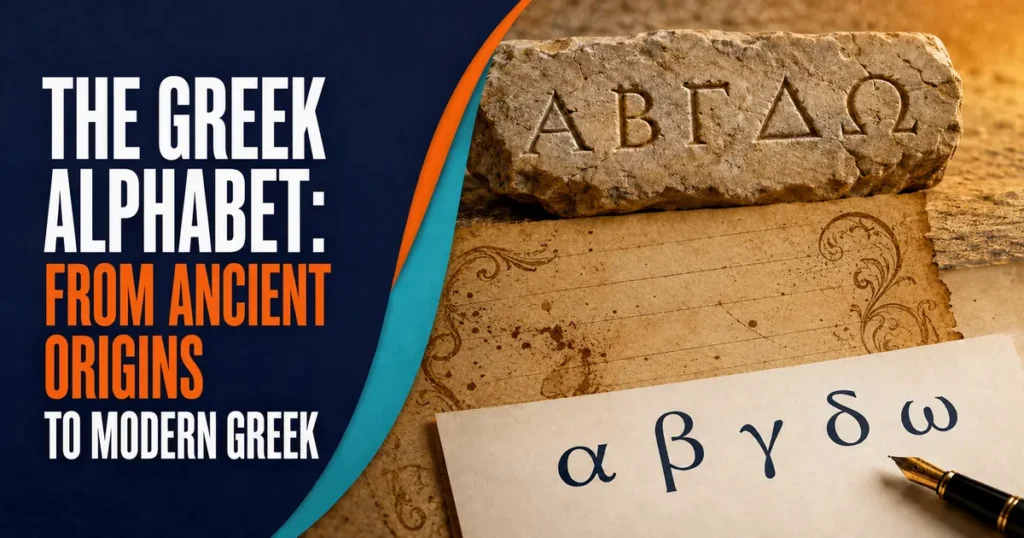
Is the Greek in Homer, the New Testament and a conversation in Athens today the same language? The surprising answer is both yes and no. They belong to one extraordinarily long Greek tradition and use versions of the same Greek alphabet, but their pronunciation, grammar, vocabulary and writing conventions belong to different historical stages.
That continuity makes Greek unusual. A modern reader can recognise many letters carved more than two millennia ago, yet recognising a letter is not the same as understanding the language. Before we follow the whole story, try the short challenge below.
Can you decode the Greek alphabet story?
Choose the most accurate answer. A few options are designed to tempt confident guessers.
Before the Greek alphabet: Linear B
Greek had been written before the alphabet existed. Mycenaean palace administrators used Linear B during the second millennium BCE, mainly for inventories and records. It was a syllabary: its signs generally represented syllables rather than individual consonants and vowels.
When the Mycenaean palace system collapsed, Linear B disappeared from use. Several centuries later, alphabetic Greek writing emerged in a different cultural world. Linear B proves that Greek had an earlier written history, but it was not the direct parent of alpha, beta and gamma.
Where did the Greek alphabet come from?
The strongest evidence points to the Phoenician script. Early Greek letter shapes, their order and even names such as alpha, beta and gamma reflect Phoenician models. Contact between Greek and Phoenician communities around the Mediterranean provided the setting for adaptation, probably during the ninth or eighth century BCE. The exact place and date remain debated, so a precise inventor or birthday would be misleading.
Phoenician writing was exceptionally well suited to a Semitic language and primarily represented consonants. Greek required a different solution. Its users reassigned signs for consonants that Greek did not need and made them represent vowel sounds. In simplified terms, Phoenician aleph helped produce Greek alpha, while other signs became epsilon, iota, omicron and upsilon.
The earliest Greek writing did not look completely modern
There was no single uniform alphabet across the entire Greek-speaking world at first. Communities used local, or epichoric, alphabets. Some had different letter shapes, omitted symbols used elsewhere or represented the same sound in another way.
Writing direction also varied. Some inscriptions run from right to left, following Phoenician practice. Others use boustrophedon: one line travels in one direction and the next reverses, like an ox turning while ploughing a field. Left-to-right writing eventually became standard.
A major standardising moment came when Athens officially adopted the Ionic alphabet in 403/402 BCE. It was not the instant invention of the modern system, but the Ionic set became increasingly influential and supplied the familiar 24-letter framework.
The 24 letters of the Greek alphabet
The table below gives conventional English letter names and an accessible guide to Modern Greek pronunciation. Approximation has limits: sounds such as gamma and chi change according to the following vowel, and English does not always offer an exact equivalent.
| Uppercase | Lowercase | Name | Approximate Modern Greek sound |
|---|---|---|---|
| Α | α | Alpha | a as in father |
| Β | β | Beta (Modern Greek: vita) | v as in very |
| Γ | γ | Gamma | A soft voiced sound; changes before e/i sounds |
| Δ | δ | Delta | th as in this |
| Ε | ε | Epsilon | e as in met |
| Ζ | ζ | Zeta (Modern Greek: zita) | z as in zoo |
| Η | η | Eta (Modern Greek: ita) | ee as in see |
| Θ | θ | Theta | th as in think |
| Ι | ι | Iota | ee as in see |
| Κ | κ | Kappa | k |
| Λ | λ | Lambda | l |
| Μ | μ | Mu (Modern Greek: mi) | m |
| Ν | ν | Nu (Modern Greek: ni) | n |
| Ξ | ξ | Xi | ks as in books |
| Ο | ο | Omicron | o |
| Π | π | Pi | p |
| Ρ | ρ | Rho (Modern Greek: ro) | Rolled or tapped r |
| Σ | σ / ς | Sigma | s; ς is used at the end of a word |
| Τ | τ | Tau (Modern Greek: taf) | t |
| Υ | υ | Upsilon (Modern Greek: ipsilon) | ee as in see |
| Φ | φ | Phi (Modern Greek: fi) | f |
| Χ | χ | Chi | Like Scottish ch in loch, softer before e/i |
| Ψ | ψ | Psi | ps |
| Ω | ω | Omega | o |
Several letters share the same sound in Modern Greek. For example, η, ι and υ are all pronounced /i/ in standard speech. Their spellings preserve history and help distinguish words, much as English spelling records earlier pronunciations.
From capitals to lowercase and accents
Early inscriptions were normally written in capital forms, often without the spaces and punctuation familiar today. Rounded, connected writing developed through handwriting on papyrus and parchment. During the Byzantine period, minuscule book hands helped shape the lowercase letters used in printed and handwritten Greek.
Ancient texts were later supplied with breathings and accent marks by scholars and scribes. For centuries, printed Greek commonly used a polytonic system with several accent and breathing signs. Modern Greece officially adopted a simpler monotonic orthography in 1982, normally using one accent mark and the diaeresis where required. Classical and Biblical editions may still use polytonic conventions.
Ancient, Biblical and Modern Greek: what is the difference?
Labels such as “Ancient Greek” and “Biblical Greek” refer primarily to stages and varieties of the language, not to separate alphabets. The 24 letters provide visible continuity, but the language behind them changed continuously.
| Stage | Approximate setting | What makes it distinctive? |
|---|---|---|
| Mycenaean Greek | Second millennium BCE | Recorded in Linear B, before the Greek alphabet. |
| Archaic and Classical Greek | c. 8th–4th centuries BCE | Many dialects, including Attic; language of Homeric epic, drama, philosophy and classical prose. |
| Koine or Biblical Greek | Hellenistic and Roman periods | A widely shared “common” Greek that developed chiefly from Attic and spread after Alexander’s conquests. Used for the New Testament and much of the Septuagint. |
| Medieval or Byzantine Greek | Broadly late antiquity to the 15th century | A long bridge between Koine and modern varieties; pronunciation and grammar continued to evolve. |
| Modern Greek | Modern era to today | A living language with contemporary vocabulary, changed pronunciation and a largely monotonic writing system. |
Classical Greek is not one single voice
“Ancient Greek” covers centuries and several dialects. Students often begin with Classical Attic because it is associated with Athens and a vast literary corpus. Homeric Greek is different again: it is an artistic mixture with archaic features rather than ordinary fifth-century Athenian conversation.
What exactly is Biblical Greek?
Biblical Greek usually means Koine Greek, especially the language of the New Testament and the Greek Jewish scriptures known as the Septuagint. Koine means “common”. It spread widely across the eastern Mediterranean and beyond, serving people with varied first languages.
It developed from earlier Greek rather than appearing as a special sacred code. Compared with Classical Attic, many grammatical patterns became less complex or changed in frequency, while the vocabulary reflects Hellenistic, Jewish and early Christian contexts. The University of Texas offers a useful academic introduction to New Testament Greek.
Modern Greek is the continuation, not a replacement
Modern Greek descends through Koine and Medieval Greek. It is not identical to its ancestors, just as modern English is not Old English. A learner of Modern Greek gains genuine advantages when approaching older texts: the letters become familiar and much vocabulary feels recognisable. Nevertheless, serious reading of Plato or the New Testament still requires the grammar, meanings and historical context of the relevant period.
Why Greek pronunciation changed
Sound change is normal in every living language. Classical beta was pronounced closer to English b; Modern Greek beta is /v/. Classical phi was an aspirated p-type sound before it became /f/. Eta moved through a long historical process towards the modern /i/ sound, while chi developed from an aspirated stop towards the fricative heard today.
This explains why learners may encounter different classroom systems. Classical courses often use a reconstructed Attic pronunciation. Biblical Greek courses may use an Erasmian, reconstructed Koine or Modern Greek-based system. The important question is not “Which one is the only real Greek pronunciation?” but “Which historical stage and learning goal does this system represent?”
A short Greek alphabet timeline
c. 1600–1200 BCE: Mycenaean Greek is recorded in Linear B.
c. 9th–8th centuries BCE: Greek speakers adapt Phoenician writing and give vowel letters a systematic role.
8th–5th centuries BCE: local Greek alphabets coexist; direction and letter forms vary.
403/402 BCE: Athens officially adopts the Ionic alphabet, an important step towards standardisation.
Hellenistic and Roman periods: Koine becomes an international language and carries Jewish and Christian texts.
Byzantine centuries: handwriting traditions develop forms that contribute to Greek lowercase.
1982: Greece officially adopts monotonic orthography for standard modern use.
How the Greek alphabet changed the wider world
The story does not stop in Greece. A western Greek alphabet influenced Etruscan writing, which in turn helped shape the Latin alphabet used for English. Greek also contributed substantially to the development of Cyrillic through the scholarly and religious world of Byzantium.
Greek letters remain international tools. Pi represents a mathematical constant, sigma can represent a sum, delta often indicates change, lambda appears in physics and computing, and alpha and omega express beginnings and endings. The alphabet is therefore both an everyday writing system and a global scientific vocabulary.
For a closer look at variable early scripts and writing direction, the Open University’s free Ancient Greek writing resource provides clear examples.
How to start learning the Greek alphabet
- Learn letters in useful groups. Begin with familiar-looking forms, then letters whose appearance or sound may mislead an English reader.
- Study uppercase and lowercase together. Signs, book titles and names may use capitals, while ordinary text relies on lowercase.
- Read syllables aloud. The alphabet becomes memorable when it carries sound rather than remaining a visual list.
- Notice combinations. Modern Greek spelling uses letter pairs whose sound cannot always be guessed from one letter alone.
- Write real words. Start with names and transparent words, then move to greetings and short sentences.
You can check your current foundation with our Greek proficiency test. Learners who want structured tuition can explore our main Greek courses. We also provide local options such as Greek courses in Durham, alongside online lessons available across the UK.
Frequently asked questions about the Greek alphabet
How many letters does the Greek alphabet have?
The standard Greek alphabet has 24 letters, from alpha to omega.
Did the Greeks invent their alphabet from nothing?
No. They adapted a Phoenician model, changing it to suit Greek and systematically using signs for vowels. The exact date and location of the adaptation remain debated.
Is Linear B an early version of the Greek alphabet?
No. Linear B recorded an earlier form of Greek, but it is a syllabary and belongs to a separate writing tradition.
Is Biblical Greek the same as Ancient Greek?
Biblical Greek is usually Koine, a post-Classical form of Ancient Greek. It developed chiefly from Attic and differs from Classical Greek in grammar, vocabulary, usage and pronunciation.
Can a Modern Greek speaker read the New Testament?
A Modern Greek speaker can recognise the script and a great deal of vocabulary, but full comprehension requires familiarity with Koine grammar, older meanings and the historical context.
Why does sigma have two lowercase forms?
The form σ is used within a word, while ς appears at the end. They represent the same letter and sound.
Turn 24 letters into a living language
The alphabet is the doorway, not the entire house. Talk and Chalk’s private Greek lessons can help you move from recognising symbols to reading, listening and speaking with confidence, with a programme matched to Modern Greek or your specific learning goals.
