
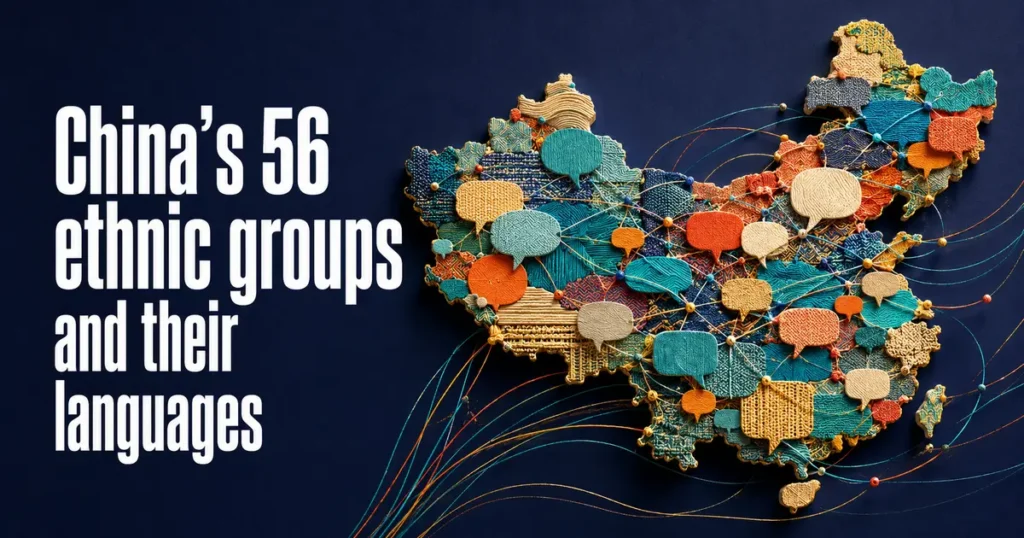
China is often described as a single civilisation united by a single language. In reality, the ethnic groups in China form one of the world’s most intricate cultural and linguistic landscapes. The state officially recognises 56 groups — the Han majority and 55 minority groups — yet the country is home to far more than 56 languages.
From the Tibetan Plateau and the Central Asian oases of Xinjiang to the tropical south-west and the great coastal cities, China contains communities shaped by very different histories, landscapes and neighbours. Mandarin connects much of the country, but it is only one part of the story.
Who are the 56 ethnic groups in China?
The official Chinese classification uses the term minzu (民族). It recognises the Han as one group and 55 groups as ethnic minorities. The categories were developed through a twentieth-century identification process that considered language, history, territory, customs and self-identification.
China’s seventh national census recorded approximately 1.286 billion Han people in 2020, equal to 91.11% of the mainland population. The combined minority population was about 125.47 million, or 8.89%. National percentages can be misleading, however: a group that is small across China may be locally prominent or form the majority in a particular county or community.
Why 56 ethnic groups do not mean 56 languages
Ethnicity is not a language count. Many Hui people, for instance, speak the Sinitic language of the region where they live rather than a separate “Hui language”. The Yao category, by contrast, includes communities speaking Iu Mien, Bunu and other languages. The Yugur are associated with both a Turkic language in the west and a Mongolic one in the east.
Estimates vary because linguists and institutions do not draw the language–dialect boundary in exactly the same place. An official government white paper reported more than 80 spoken minority languages and 28 scripts used by 21 minority groups. Ethnologue lists 284 living indigenous languages in China, while a chapter in the Cambridge Handbook of Heritage Languages and Linguistics refers to more than 400 heritage languages. These totals use different definitions, so they illuminate different parts of the same multilingual reality.
“Chinese” and Mandarin are not quite the same thing
Standard Mandarin, known in China as Putonghua (普通话), is the national common language. It is based chiefly on Beijing pronunciation and is central to national education, broadcasting and public life. It gives people from distant regions a shared spoken medium.
Yet “Chinese” can also refer to the wider Sinitic branch. This includes Mandarin varieties as well as Yue — including Cantonese — Wu, Min, Hakka, Xiang, Gan, Jin and many local forms. Some are not mutually intelligible in speech. Speakers may share a character-based writing tradition but be unable to follow one another’s everyday conversation.
That is why the familiar phrase “Chinese alphabet” needs care: Chinese characters do not work like the Latin alphabet used for English. If you would like to understand the writing system, radicals and romanisation more clearly, read our beginner’s guide to the Chinese writing system.
The major language families found across China
The country sits at a crossroads of East, Central, South-East and Himalayan Asia. Its languages belong to several major families:
Sinitic, Tibetan, Yi, Bai, Lisu, Lahu, Qiang, Jingpo and many other languages.
Zhuang, Bouyei, Dong, Dai, Shui, Mulam, Maonan, Hlai and Gelao.
Miao or Hmong languages and several Yao or Mien languages.
Uyghur, Kazakh, Kyrgyz, Salar, Uzbek, Tatar and Western Yugur.
Mongolian, Dongxiang, Bonan, Daur and Monguor; Manchu, Xibe, Evenki, Oroqen and Hezhen.
Wa, Blang, De’ang and Vietnamese; Indigenous languages of Taiwan; Russian and Pamiri Iranian languages.
Complete guide to China’s 56 official groups and their languages
This table links each official category with its best-known languages. It is a starting point rather than a rigid rule. Multilingualism is common, and many people now use Mandarin or a regional Sinitic variety as their main everyday language.
| # | Official group | Language(s) commonly associated | Family or note |
|---|---|---|---|
| 1 | Han | Mandarin, Wu, Yue/Cantonese, Min, Hakka, Xiang, Gan, Jin and others | Sinitic languages |
| 2 | Zhuang | Zhuang languages | Kra–Dai |
| 3 | Hui | Usually Mandarin or another local Sinitic variety | No single separate Hui language |
| 4 | Manchu | Manchu; now chiefly Mandarin | Tungusic; Manchu is critically endangered |
| 5 | Uyghur | Uyghur | Turkic |
| 6 | Miao | Miao/Hmong languages | Hmong–Mien; internally diverse |
| 7 | Yi | Yi or Ngwi languages | Sino-Tibetan; modern Yi syllabary |
| 8 | Tujia | Tujia; Chinese widely used | Sino-Tibetan |
| 9 | Tibetan | Tibetic languages | Sino-Tibetan |
| 10 | Mongol | Mongolic languages | Mongolic |
| 11 | Dong | Kam or Dong | Kra–Dai |
| 12 | Bouyei | Bouyei | Kra–Dai |
| 13 | Yao | Iu Mien, Bunu and other languages | Linguistically diverse category |
| 14 | Bai | Bai | Usually classified as Sino-Tibetan |
| 15 | Korean | Korean | Koreanic |
| 16 | Hani | Hani and Akha | Sino-Tibetan |
| 17 | Li | Hlai languages | Kra–Dai |
| 18 | Kazakh | Kazakh | Turkic |
| 19 | Dai | Tai Lü, Tai Nüa and other Tai languages | Kra–Dai |
| 20 | She | She; Hakka and Chinese are widespread | Hmong–Mien |
| 21 | Lisu | Lisu | Sino-Tibetan |
| 22 | Gelao | Gelao; Chinese widely used | Kra–Dai |
| 23 | Dongxiang | Dongxiang or Santa | Mongolic |
| 24 | Lahu | Lahu | Sino-Tibetan |
| 25 | Shui | Shui or Sui | Kra–Dai |
| 26 | Wa | Wa | Austroasiatic |
| 27 | Naxi | Naxi | Sino-Tibetan |
| 28 | Qiang | Qiangic languages | Sino-Tibetan |
| 29 | Tu | Monguor languages | Mongolic |
| 30 | Xibe | Xibe | Tungusic |
| 31 | Mulao | Mulam | Kra–Dai |
| 32 | Kyrgyz | Kyrgyz | Turkic |
| 33 | Daur | Daur | Mongolic |
| 34 | Jingpo | Jingpho, Zaiwa and related languages | Sino-Tibetan |
| 35 | Salar | Salar | Turkic |
| 36 | Blang | Blang and related Palaungic languages | Austroasiatic |
| 37 | Maonan | Maonan | Kra–Dai |
| 38 | Tajik | Mainly Sarikoli and Wakhi | Pamiri Iranian languages |
| 39 | Pumi | Prinmi or Pumi | Sino-Tibetan |
| 40 | Achang | Achang | Sino-Tibetan |
| 41 | Nu | Nusu, Anong and other languages | Linguistically diverse category |
| 42 | Ewenki | Evenki | Tungusic |
| 43 | Gin/Jing | Vietnamese | Austroasiatic |
| 44 | Jino | Jino | Sino-Tibetan |
| 45 | De’ang | De’ang and related Palaungic languages | Austroasiatic |
| 46 | Bonan | Bonan | Mongolic |
| 47 | Russian | Russian | Indo-European |
| 48 | Yugur | Western Yugur and Eastern Yugur | Turkic and Mongolic respectively |
| 49 | Uzbek | Uzbek | Turkic |
| 50 | Monba | Several Eastern Bodish languages, including Tshangla | Sino-Tibetan |
| 51 | Oroqen | Oroqen | Tungusic |
| 52 | Derung | Drung or Dulong | Sino-Tibetan |
| 53 | Tatar | Tatar | Turkic |
| 54 | Hezhen | Hezhen or Nanai | Tungusic |
| 55 | Lhoba | Several languages of eastern Himalayan communities | Official multilingual umbrella |
| 56 | Gaoshan | Multiple Austronesian Indigenous languages of Taiwan | Umbrella term used in mainland classification |
Many languages — and many writing systems
Linguistic diversity is visible on the page as well as audible in conversation. Chinese characters are used for Mandarin and other Sinitic languages. Tibetan has its own alphasyllabary; modern Uyghur is written mainly in an adapted Arabic script; traditional Mongolian runs vertically; Korean uses Hangul; and modern standard Yi employs a syllabary. Other languages use Latin- or Cyrillic-based orthographies, while some rely strongly on oral traditions.
Writing can carry spiritual and historical meaning too. The Dongba manuscripts associated with Naxi tradition are famous for their pictographic signs. They are not simply an everyday “Naxi alphabet”, but part of a specialist ritual and literary heritage. Such examples remind us that a writing system is not merely a technical code: it can preserve memory, worldview and identity.
How multilingualism works in everyday life
A person may use a heritage language at home, a regional Sinitic variety in the neighbourhood and Standard Mandarin at school or work. Migration, urbanisation, mixed families and education can alter that balance from one generation to the next. English or another foreign language may become an additional layer.
Mandarin enables communication across an enormous country. At the same time, a local language survives only when children continue to learn and use it. Family transmission, schooling, media and community life all matter. The UNESCO Atlas of the World’s Languages in Danger documents the vulnerability of a number of minority languages in China, including languages with very small speaker populations.
Why linguistic diversity matters
Languages carry knowledge that cannot always be translated neatly: ways of naming landscapes and plants, forms of oral history, kinship systems, humour, songs and spiritual practices. When a language disappears, humanity may lose a unique archive of experience.
China’s diversity also helps us use familiar terms more accurately. “Chinese”, “Mandarin”, “Han” and “Chinese citizen” are not synonyms. Mandarin is a language; Han is an official ethnic category; “Chinese” may refer to nationality, culture, writing or a family of languages depending on context. Precision is not pedantry here — it is respect.
Learning Mandarin: the best gateway, but not the whole house
For most learners in the UK, Standard Mandarin is the practical starting point. It opens access to an international language used in education, travel, business and family life by vast numbers of people. Once you begin listening closely, however, you will also notice regional accents, local vocabulary and other languages surrounding it.
A strong course should connect pronunciation, tones, characters and grammar with real situations. Cultural context is not an optional extra: it helps you understand why a phrase is chosen, how politeness works and what may change between regions. Our tailored Mandarin courses are built around your level, aims and schedule, whether you are learning for work, travel, study, family or curiosity.
Frequently asked questions
Does China have exactly 56 ethnicities?
China officially recognises 56 ethnic groups: the Han and 55 minority groups. This is an administrative classification. Local identities and the boundaries between communities can be more complex.
Does each minority group have its own language?
No. Some groups use several languages, some share a language with another group, and some mainly speak Mandarin or another regional Sinitic language. There is no one-to-one match between 56 groups and 56 languages.
Is Cantonese a dialect of Mandarin?
No. Cantonese belongs to the Yue branch of Sinitic, while Mandarin belongs to another branch. They share important elements of history and writing, but spoken Cantonese and spoken Mandarin are not mutually intelligible.
Which is China’s largest minority group?
The Zhuang are generally the largest officially recognised minority group in national statistics. They are concentrated chiefly in Guangxi and speak several Zhuang languages, although Mandarin and other Sinitic varieties are also widely used.
How many languages are spoken in China?
There is no universally accepted total. Counts range from more than 80 minority spoken languages in some official sources to several hundred living or heritage languages in linguistic catalogues, depending on definitions and whether closely related varieties are counted separately.
Quiz: how well do you know China’s linguistic diversity?
Try these five quick questions.
Ready to see Mandarin in a wider cultural context?
Learn with a teacher, a programme shaped around your goals and cultural explanations that make the language memorable.
