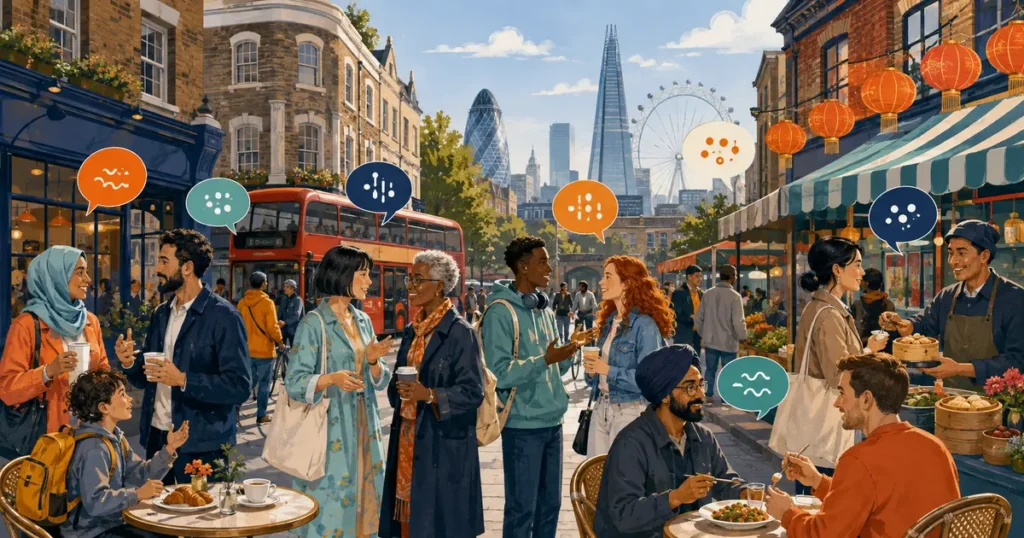
How many languages can you hear in London? Far more than a visitor could count in one Tube journey. English connects the capital, but Bengali, Polish, Punjabi, Urdu, Arabic, French, Turkish, Portuguese, Spanish, Korean, Chinese languages and many others shape its streets, schools, shops and homes.
Languages spoken in London are not neatly divided by postcode. Communities overlap, people move and every neighbourhood changes. Yet certain areas have strong historical and cultural associations that make the city feel like a living language map.
This guide takes you from Brick Lane to Southall, New Malden and Green Lanes, then looks at affluent areas such as Kensington, Chelsea, Mayfair, Hampstead, Richmond and Wimbledon, where languages are often learned for travel, international work, education and family life.
The London language detective game
Five neighbourhoods, five languages. Choose the association most strongly linked with each area. The wrong options are deliberately believable.
1. Brick Lane and parts of Tower Hamlets
2. Southall
3. New Malden
4. South Kensington
5. Green Lanes in Haringey
Scored five? Impressive. Scored fewer? Excellent — you now have a reason to read the neighbourhood map below.
Why are so many languages spoken in London?
London has grown through centuries of trade, migration, diplomacy, education and creative exchange. According to the Office for National Statistics’ Census 2021 language data, Polish, Romanian, Punjabi and Urdu were among the most common main languages after English across England and Wales. London’s mix is even more visible in everyday life.
Language and ethnicity are not the same thing, and a census category cannot capture every multilingual household. A Londoner may use Bengali with grandparents, English at work and Arabic or French at school. That is why this is a cultural guide rather than a set of rigid borders.
A cultural map of languages across London neighbourhoods
Brick Lane and Tower Hamlets: Bengali and Sylheti
Brick Lane is famous for street art, markets and restaurants, but its Bengali heritage is much deeper than a weekend visit suggests. Banglatown and the surrounding parts of Tower Hamlets reflect decades of British Bangladeshi history. Bengali is widely recognised, while many families have roots in Sylhet and use Sylheti in daily conversation.
The area is a reminder that learning a language also means learning how identity, migration and local history interact. It is not simply a vocabulary exercise.
Southall: Punjabi, Hindi and Urdu
Southall in West London is closely associated with South Asian culture. Shop signs, music, places of worship, food businesses and family networks create an environment where Punjabi, Hindi and Urdu can all be heard. The languages are distinct, even when speakers may share vocabulary or switch between them.
For learners, Southall demonstrates why real communication rarely follows a textbook in a perfectly tidy way.
New Malden: Korean
New Malden is well known for its Korean community, food shops, restaurants, churches and businesses. Korean language and culture have a visible local presence, reinforced by the global popularity of Korean cinema, television, music and cuisine.
Someone learning Korean in London can therefore connect classroom knowledge with authentic cultural experiences without leaving the capital.
Green Lanes and Haringey: Turkish and Kurdish
Along Green Lanes and in parts of Haringey, Turkish and Kurdish businesses, restaurants and community organisations have shaped the local character. The two languages should not be treated as interchangeable, but both form part of the area’s multilingual story.
If Turkish interests you, our Turkish courses in London can turn curiosity sparked by the neighbourhood into structured learning.
Edgware Road: Arabic
Arabic signage, cafés, restaurants and specialist shops give stretches of Edgware Road a distinctive character. Arabic itself includes many regional varieties, while Modern Standard Arabic has a different role in formal writing and media.
Our Arabic courses in London can be adapted to a learner’s purpose, whether that is conversation, family communication, travel or professional use.
South Kensington: French
South Kensington has long-standing French institutions, schools, bookshops and cultural connections. French can also be heard far beyond this neighbourhood, but the area remains an obvious reference point for Francophone London.
Learners can explore French courses in London for private, online or tailored lessons. A museum visit, film programme or café conversation can then become part of the learning routine.
Stockwell and the Portuguese-speaking city
Stockwell has a strong historic association with Portuguese-speaking communities, particularly from Portugal and several African countries. Brazilian Portuguese is also increasingly visible across London through businesses, events, music and family connections.
Because Portuguese is not one single accent or culture, learners should choose the variety that matches their goals. Talk and Chalk offers both Portuguese courses in London and dedicated Brazilian Portuguese courses in London.
Elephant and Castle: Spanish and Latin American connections
Elephant and Castle has long been an important reference point for Latin American communities, even as redevelopment has changed the area. Spanish appears in cafés, shops, community activities and cultural events, while Latin American London extends well beyond one neighbourhood.
Our Spanish courses in London can focus on travel, family, professional communication or a particular regional variety.
Polish London: a community beyond one postcode
Polish London is less easily reduced to one famous street. Long-established associations can be found in areas of West London, including Ealing and Hammersmith, while Polish speakers live throughout the capital. That wider distribution is itself part of modern London’s story.
People learning for family, work or cultural reasons can explore our Polish courses in London.
Affluent London neighbourhoods where language learning fits everyday life
Not every useful language link comes from a concentrated heritage community. In London’s wealthier residential and professional districts, learners often choose languages because their lives are international: children attend multilingual schools, families own or visit homes abroad, executives work across borders and cultural travel is part of the calendar.
| Area | Why learners may need languages | Natural options |
|---|---|---|
| Kensington & Chelsea | International families, schools, culture, diplomacy and travel | French, Spanish, Arabic, English |
| Knightsbridge & Belgravia | International business, hospitality, property and family life | Arabic, French, Mandarin, English |
| Mayfair & Marylebone | Finance, luxury services, private clients and international networks | English, Arabic, French, Spanish |
| Hampstead | Education, culture, globally connected households and relocation | French, German, Spanish, English |
| Richmond & Wimbledon | Families, international schooling, travel and long-term learning | French, Spanish, German, English |
| Notting Hill | Creative industries, international residents and cultural interests | Portuguese, French, Spanish, English |
| Canary Wharf | Finance, global teams, presentations, negotiations and relocation | Business English, Mandarin, Portuguese, Spanish |
These suggestions describe common learning motivations, not the identity of every resident. A learner in Mayfair may want Japanese for a personal passion; a family in Richmond may choose Brazilian Portuguese because of relatives. The best course begins with the person, not the postcode.
From London’s streets to confident conversation
Simply living near a multilingual community does not automatically teach you its language. You may recognise a menu, greeting or shop sign, but confident speaking requires feedback, repetition and a course designed around your objectives.
Our language courses are available online and, depending on location and teacher availability, in person. Lessons can be arranged for adults, children, families and companies. Newcomers who need practical local communication can also explore English courses in London.
Choose a language that belongs in your life
Start with one real reason: a trip, a relationship, a child’s education, a new role or a culture you want to understand. Talk and Chalk can match the course, schedule and teacher to that goal.
Frequently asked questions about languages spoken in London
What are the most common languages spoken in London besides English?
The answer depends on whether we count main language, ability, heritage use or occasional use. Census data identifies large populations using languages including Polish, Romanian, Punjabi, Urdu, Bengali and Arabic, while London is also home to substantial French, Spanish, Portuguese, Turkish, Chinese and many other language communities.
Which London neighbourhood is best for experiencing different languages?
There is no single best area. Brick Lane, Southall, New Malden, Green Lanes, Edgware Road, South Kensington, Stockwell and Elephant and Castle each offer different cultural connections. The most rewarding approach is to visit respectfully and learn the history behind what you see.
Can I take private language lessons in affluent London neighbourhoods?
Yes. Private lessons may be available online or in person, subject to the language, location and teacher availability. Areas such as Kensington, Chelsea, Mayfair, Hampstead, Richmond and Wimbledon are well suited to tailored family, professional and travel-focused programmes.
Is one dialect or variety of a language taught?
That depends on your objective. Arabic, Portuguese, Spanish, Chinese languages and English all have important regional varieties. A good needs assessment identifies which variety, accent and context will be most useful to you.
Why learn a language if most Londoners speak English?
Because language gives access to relationships, humour, culture and trust that translation alone cannot reproduce. It can also support international work, travel, education and a stronger connection with London’s communities.
