
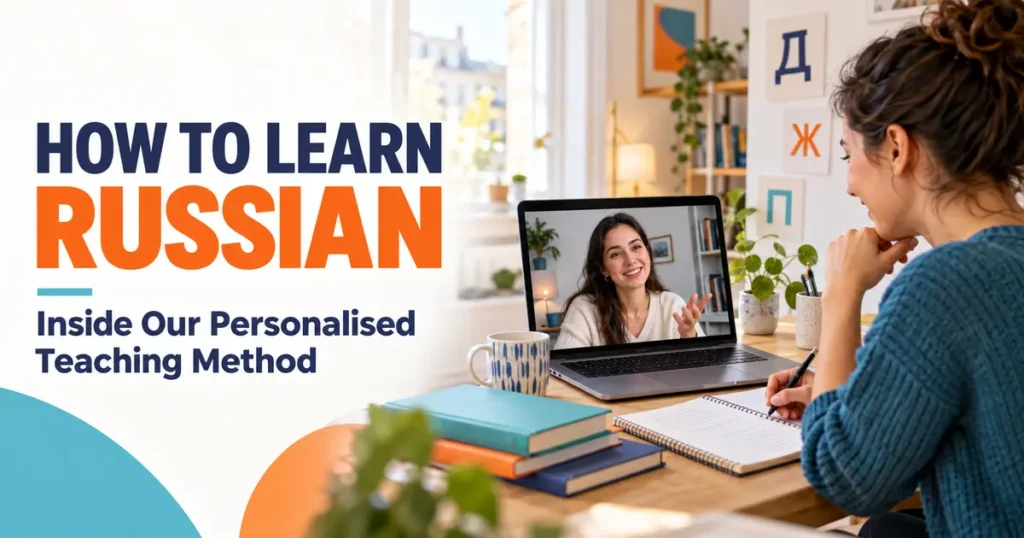
How to learn Russian without spending months memorising rules you still cannot use in conversation? Start with a course built around what you need to do in the language. At Talk and Chalk, private Russian tuition combines live communication, a clear foundation in Cyrillic, carefully selected grammar and regular feedback from an experienced tutor.
This guide takes you inside our teaching method, explains what happens before and during a course, and shows how we adapt Russian lessons for beginners, returning learners, professionals and advanced students.
What would a good Russian tutor do?
Choose the most useful teaching decision in each situation. Your result will reveal whether you can recognise genuinely personalised tuition.
How to learn Russian with a personalised plan
No two learners arrive with the same history. One person may already recognise Cyrillic because of family connections, while another may speak informally but never have studied cases. A professional learner may need meetings and emails; a literature enthusiast may care more about reading and cultural context.
That is why our first step is not choosing a textbook chapter. We identify your starting point, reasons for learning, weekly availability and the situations in which you want to use Russian. If you have studied before, our online Russian proficiency test can provide an initial diagnostic snapshot. A tutor may then check speaking, listening and writing separately, because a multiple-choice test cannot measure every skill.
Private Russian lessons: what makes them different?
In a large class, speaking time must be shared. In a private lesson, the tutor can listen closely to your pronunciation, notice recurring errors and change direction when a concept needs more work. The lesson can also move faster when you already understand a topic.
If you are deciding how to learn Russian as an adult with limited time, this individual attention prevents you from spending entire lessons on content that does not match your priorities.
One-to-one tuition allows us to:
- build lessons around your personal, academic or professional goals;
- adapt the balance between conversation, grammar, reading and writing;
- choose vocabulary that matches your life and interests;
- correct patterns rather than interrupting every sentence;
- review difficult points before they become permanent habits;
- set realistic independent work between lessons;
- change the pace when your availability or priorities change.
Private tuition is particularly valuable in Russian because learners often develop uneven profiles. Someone may decode the alphabet confidently but find noun cases confusing. Another learner may understand family conversations yet struggle to write. Individual lessons make those differences visible.
Online Russian lessons with native-speaking tutors
Our online Russian lessons are live video sessions, not a library of pre-recorded lectures. You interact with your tutor in real time, share documents and screens, practise pronunciation, complete guided tasks and receive immediate feedback.
For anyone wondering how to learn Russian from home without losing human interaction, live tuition offers the flexibility of digital learning with the guidance of a real teacher.
Many of our online tutors are native Russian speakers based in Russia; others may live elsewhere and bring different professional or teaching experience. Tutor availability varies, so we match each learner according to level, objectives, timetable and the expertise required. Native-speaker status can provide natural pronunciation and cultural insight, but good teaching also depends on preparation, explanation, patience and the ability to adapt.
For UK-based learners, online tuition offers several practical benefits:
- a wider choice of specialist tutors;
- less travel and easier scheduling;
- continued lessons during work trips or holidays;
- digital materials that remain accessible after class;
- regular contact with authentic contemporary Russian.
Face-to-face Russian tuition in the UK
Some learners prefer sharing the same physical space with a tutor. Subject to local availability, face-to-face lessons may take place at the student’s home, the teacher’s premises or another agreed location. We confirm the venue, travel arrangements, lesson length and availability before the course begins.
Face-to-face learning can work especially well for young learners, families, intensive programmes and students who concentrate better away from a screen. However, the teaching principles remain the same: clear goals, active participation, personalised feedback and a balanced development of skills.
Learners looking for a local option can explore our Russian courses in Guildford. Online tuition remains available throughout the United Kingdom when a suitable local tutor is not available.
How we teach the Cyrillic alphabet
Cyrillic often looks like the first major obstacle, but it is a finite system that beginners can start using surprisingly early. We do not treat it as a decorative code or rely indefinitely on Latin transliteration. Instead, the tutor connects letters with sounds, familiar international words and short, useful examples.
Understanding how to learn Russian script efficiently means using the alphabet immediately, rather than separating it from vocabulary and communication.
A typical early sequence may include:
- recognising letters that look and sound familiar;
- identifying “false friends” such as letters that resemble Latin characters but represent different sounds;
- reading syllables and high-frequency words;
- writing names, greetings and short phrases;
- gradually reducing transliteration;
- reading authentic signs, messages and simple texts.
The objective is functional literacy. Correct handwriting and spelling matter, but the alphabet becomes useful when it supports communication rather than delaying it.
Grammar that serves communication
Russian grammar includes grammatical gender, verb aspect, motion verbs and a case system. These features deserve careful explanation, yet memorising tables alone rarely produces confident communication.
Our tutors introduce grammar through meaning and use. A learner might practise the accusative case while ordering food or describing a planned activity, then compare examples and notice the pattern. Later exercises reinforce accuracy through speaking, reading and writing.
This approach does not remove grammar. It gives grammar a purpose. Learners still receive explanations, structured practice and correction, but they also use the form in a real communicative task.
Speaking and pronunciation from the beginning
Beginners do not need to wait until they “know enough grammar” before speaking. From the first stage, lessons can include greetings, introductions, simple questions, numbers and survival phrases. The tutor controls the difficulty so that the learner can communicate without being overwhelmed.
Pronunciation work may cover word stress, vowel reduction, consonant softness and rhythm. Rather than chasing an artificial idea of perfection, we aim for speech that is clear, increasingly natural and easy to understand. Learners hear a model, repeat with a purpose, compare sounds and then use them in meaningful phrases.
Real-life tasks and the CEFR
The Council of Europe’s action-oriented approach treats learners as people who use language to accomplish real tasks. This principle fits our method: a lesson may involve arranging a meeting, understanding a voice message, introducing a colleague, resolving a misunderstanding or writing a concise email.
The CEFR levels from A1 to C2 can help describe progress, but the framework is not a rigid textbook order. We use relevant “can do” objectives while recognising that listening, speaking, reading and writing may develop at different speeds.
| Stage | Typical focus in a personalised Russian course |
|---|---|
| Beginner | Cyrillic, essential pronunciation, greetings, personal information and high-frequency structures. |
| Elementary | Routine exchanges, family, directions, shopping, simple descriptions and core case patterns. |
| Intermediate | Connected conversation, narration, opinions, wider listening and more independent reading. |
| Upper levels | Nuance, register, professional or academic language, complex texts and sustained spontaneous interaction. |
Materials chosen for the learner
A course may use a core textbook, but it does not have to be limited to one. Depending on the objective, the tutor can select dialogues, graded readings, audio, short videos, images, maps, menus, messages, professional documents and teacher-created exercises.
Materials should be comprehensible enough to support learning and authentic enough to prepare the student for real Russian. A beginner needs carefully graded input; an advanced learner may benefit from unadapted interviews, articles or specialist documents.
Homework without unnecessary workload
Independent work helps maintain contact with Russian between lessons, especially when a student studies once or twice a week. However, homework should match the time the learner genuinely has available.
Useful tasks may include short vocabulary reviews, listening practice, a voice recording, a brief written message, reading aloud or preparing ideas for the next conversation. The tutor then uses the result to plan feedback and future lessons. Ten focused minutes on several days can be more valuable than a long task completed only once.
How we measure progress
Progress is more than finishing units. We look at what the learner can understand and do with greater independence. Regular review may consider fluency, accuracy, pronunciation, vocabulary range, listening comprehension, reading and writing.
The question of how to learn Russian well is therefore also a question of how to review progress honestly and adjust the next objective.
Short diagnostic activities reveal what has become automatic and what still needs support. The tutor can then adjust priorities, revisit a weak point or introduce a new challenge. Learners preparing for a specific assessment receive practice that reflects the required skills and task types.
How to learn Russian for your particular goal
| Your objective | Likely course emphasis |
|---|---|
| Family and relationships | Everyday conversation, listening, informal language and culturally appropriate interaction. |
| Work and business | Meetings, telephone calls, emails, sector vocabulary and professional register. |
| Travel | Practical speaking, signs, transport, accommodation, food and problem-solving. |
| Heritage learning | Closing literacy gaps, building confidence and connecting home language with structured study. |
| Literature and culture | Reading strategies, vocabulary, historical context and discussion of texts. |
| Examination preparation | Targeted skill practice, timing, task formats, accuracy and feedback against requirements. |
What happens before your first regular lesson?
We discuss your objective
You tell us why you want to learn Russian, how soon you hope to use it and whether you prefer online or face-to-face tuition.
We identify your starting point
Beginners can start directly. Returning learners may complete a test and a short spoken assessment.
We match the tutor
We consider availability, level, learning goals and any professional or academic specialism.
We agree the rhythm
The course schedule should be regular enough to support progress while remaining realistic for your week.
The programme evolves
Your tutor reviews progress and adjusts priorities as your Russian becomes more independent.
Frequently asked questions
Are your Russian tutors native speakers?
Many are native Russian speakers, including tutors based in Russia. We may also work with highly proficient bilingual teachers. The match depends on availability, teaching experience and the learner’s objectives.
Are online lessons pre-recorded?
No. Our online lessons are live and interactive. Recorded or digital materials may support the course, but they do not replace the tutor.
Can I take face-to-face Russian lessons anywhere in the UK?
Face-to-face tuition depends on local tutor availability and travel arrangements. When it is not available, online lessons provide access to a wider range of tutors throughout the UK.
Do I need to learn Cyrillic before starting?
No. A complete beginner can learn Cyrillic as part of the course. The tutor introduces it progressively alongside useful language.
How many Russian lessons should I take each week?
One or two regular sessions can suit many learners, provided there is some contact with Russian between lessons. Intensive schedules are possible when a deadline or immersion goal requires faster preparation.
Can lessons focus on professional Russian?
Yes. The tutor can incorporate relevant situations, documents and vocabulary once we understand your role and communication needs.
Build a Russian course around your goals
Explore our private Russian courses and tell us what you want to achieve. We will help you choose the right format, tutor and weekly rhythm for a realistic, personalised learning plan.
