
Understanding Language Levels (CEFR): A Complete Guide with Learning Timelines
Understanding language levels is essential when choosing the right course and setting realistic, motivating goals. Whether you are learning English, French, Spanish, or any other language, having a clear roadmap will help you progress efficiently.
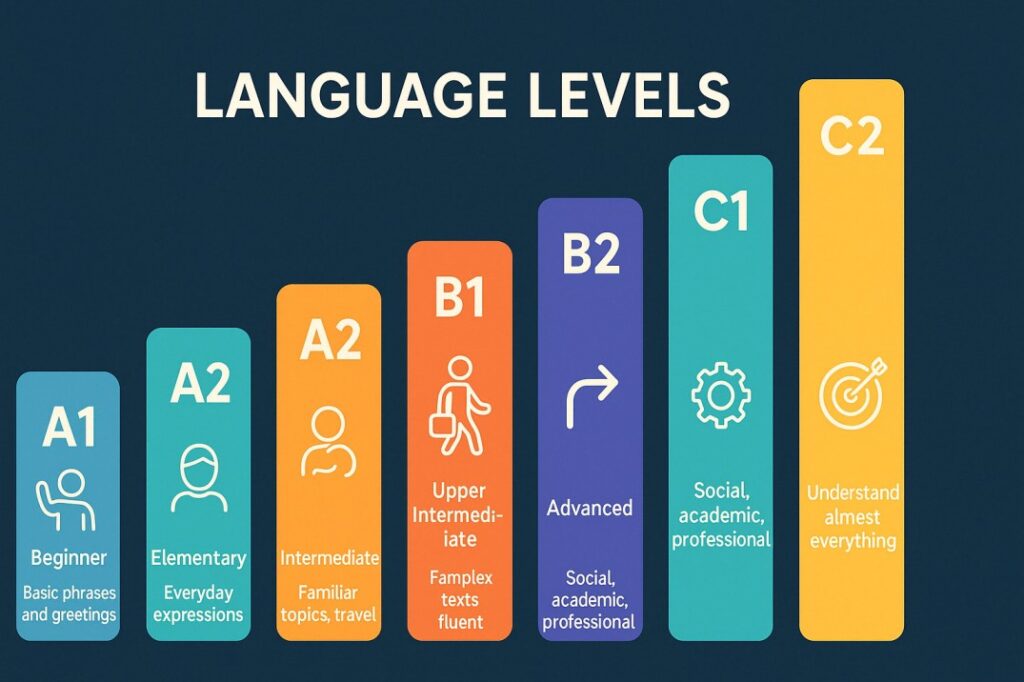
The Common European Framework of Reference for Languages (CEFR) is the most widely used international standard for measuring language proficiency. It divides learners into six levels—from A1 (Beginner) to C2 (Mastery)—grouped into three main categories:
- Basic User (A1–A2)
- Independent User (B1–B2)
- Proficient User (C1–C2)
Each level includes practical “can-do” descriptors, making it easier for learners, teachers, and employers to understand exactly what you can achieve at each stage.
CEFR Language Levels at a Glance
| Level | CEFR Code | User Category | What You Can Do |
|---|---|---|---|
| Beginner | A1 | Basic User | Use simple expressions, introduce yourself, ask basic questions |
| Elementary | A2 | Basic User | Communicate in routine situations, understand common phrases |
| Intermediate | B1 | Independent User | Handle travel, describe experiences, produce simple texts |
| Upper Intermediate | B2 | Independent User | Interact fluently, understand complex topics |
| Advanced | C1 | Proficient User | Express ideas fluently in professional and academic contexts |
| Proficiency | C2 | Proficient User | Understand everything and communicate with precision |
What Each Language Level Really Means
Understanding what each CEFR level represents in real-life situations is essential to setting clear expectations and staying motivated throughout your learning journey. The CEFR framework is based on practical communication skills, meaning each level reflects what you are actually able to do with the language—not just what you know in theory.
For a complete overview of how the CEFR works, you can also refer to the official guidelines from the Council of Europe:
https://www.coe.int/en/web/common-european-framework-reference-languages/level-descriptions
A1 – Beginner (Basic User)
At this stage, you are starting from scratch or have very limited exposure to the language. The focus is on building essential foundations such as basic vocabulary, pronunciation, and simple sentence structures.
You can:
- Introduce yourself and others
- Ask and answer simple questions about personal details
- Understand slow, clear speech when supported by gestures or context
At A1 level, communication is still very limited, and interactions often require patience from the other speaker. However, this is a crucial stage where confidence begins to develop.
Estimated duration (private classes):
- Easy languages (Spanish, Italian): 40–60 hours
- Medium (English, French): 50–70 hours
- Difficult (German): 60–80 hours
- Very difficult (Chinese, Arabic): 80–120 hours
👉 At this stage, consistency is more important than intensity. Short, regular lessons combined with exposure (apps, listening, repetition) can significantly accelerate progress. You can also explore beginner resources from the British Council:
https://learnenglish.britishcouncil.org/english-levels/understand-your-english-level
A2 – Elementary (Basic User)
At A2 level, you begin to move beyond survival phrases and start handling simple everyday situations more independently. Your vocabulary expands, and you become more comfortable forming sentences.
You can:
- Talk about familiar topics such as family, shopping, and work
- Handle simple conversations in predictable situations Language Levels
- Understand frequently used expressions and instructions
This level is often where learners start to feel more confident, although conversations may still be slow and limited.
Estimated duration (from A1 to A2):
- Easy languages: 60–80 hours
- Medium: 70–100 hours
- Difficult: 90–120 hours
- Very difficult: 120–160 hours
👉 Reaching A2 means you can begin to actively participate in basic social interactions, which is a strong motivational milestone.
B1 – Intermediate (Independent User)
B1 is a major turning point in language learning. At this stage, you become an independent user, capable of managing real-life situations without constant support.
You can:
- Travel and handle everyday situations abroad
- Describe experiences, plans, and opinions
- Understand clear standard speech on familiar topics
You are now able to maintain conversations, even if you still make mistakes or need time to express yourself.
Estimated duration (from A2 to B1):
- Easy languages: 80–120 hours
- Medium: 100–140 hours
- Difficult: 120–180 hours
- Very difficult: 180–250 hours
👉 According to many institutions, B1 is the minimum level required to function in a language for daily life. You can explore how exams align with this level here:
https://www.cambridgeenglish.org/exams-and-tests/cefr/
B2 – Upper Intermediate (Independent User)
At B2 level, your fluency significantly improves. You can interact more naturally and comfortably with native speakers, making communication smoother and more spontaneous.
You can:
- Participate actively in discussions
- Understand more complex and abstract topics
- Express detailed and structured opinions
At this stage, you begin to sound more natural and less like a learner. Language Levels
Estimated duration (from B1 to B2):
- Easy languages: 120–160 hours
- Medium: 140–200 hours
- Difficult: 180–240 hours
- Very difficult: 250–350 hours
👉 B2 is often considered the level required for professional environments or academic studies in a foreign language.
C1 – Advanced (Proficient User)
Reaching C1 means you can use the language effectively in complex and demanding situations, including professional and academic contexts.
You can:
- Express ideas fluently and spontaneously
- Understand implicit meaning and nuance
- Adapt your language depending on context and audience
At this level, communication feels natural, and you can engage in high-level discussions.
Estimated duration (from B2 to C1):
- Easy languages: 160–220 hours
- Medium: 200–260 hours
- Difficult: 240–320 hours
- Very difficult: 350–500 hours
👉 C1 is often required for university admission or high-level professional roles.
C2 – Proficiency (Proficient User)
C2 represents near-native mastery of the language. This level is achieved by a relatively small percentage of learners and requires deep immersion and long-term practice.
You can:
- Understand virtually everything you read or hear
- Summarise complex information from multiple sources
- Express yourself with precision, including subtle nuances Language Levels
At this stage, you are fully comfortable in the language, even in highly complex or specialised situations.
Estimated duration (from C1 to C2):
- Easy languages: 200–300 hours
- Medium: 250–350 hours
- Difficult: 300–400 hours
- Very difficult: 500+ hours
Total Estimated Learning Time (Private Classes)
From complete beginner (A1) to advanced fluency (C1), the total estimated time required depends significantly on the language difficulty:
- Easy languages: ~450–650 hours
- Medium languages: ~600–900 hours
- Difficult languages: ~800–1200 hours
- Very difficult languages: ~1200–2000+ hours
👉 These estimates are based on structured private lessons with a teacher. Progress can be significantly faster with:
- intensive learning programs
- immersion (living abroad, daily exposure)
- consistent practice outside of lessons
Language learning is not linear—some stages may feel faster, while others require more time and consolidation. The key is consistency, motivation, and enjoying the process.
Authoritative Resources
For further reading and self‑assessment, explore these non‑competitor, high‑authority sites:
Council of Europe CEFR Guide: Official level descriptions and companion volumes.
https://www.coe.int/en/web/common-european-framework-reference-languages/level-descriptions PortalCambridge Assessment English – CEFR Exams: Aligns Cambridge exams to CEFR levels. Language Levels
https://www.cambridgeenglish.org/exams-and-tests/cefr/British Council – Understand Your English Level: Free tests and detailed level breakdowns.
https://learnenglish.britishcouncil.org/english-levels/understand-your-english-level LearnEnglish – British Council
Ready to Identify Your Level?
Take our free CEFR-aligned placement test now and discover the perfect course to match your language level.
🔗 Start Your Test
