
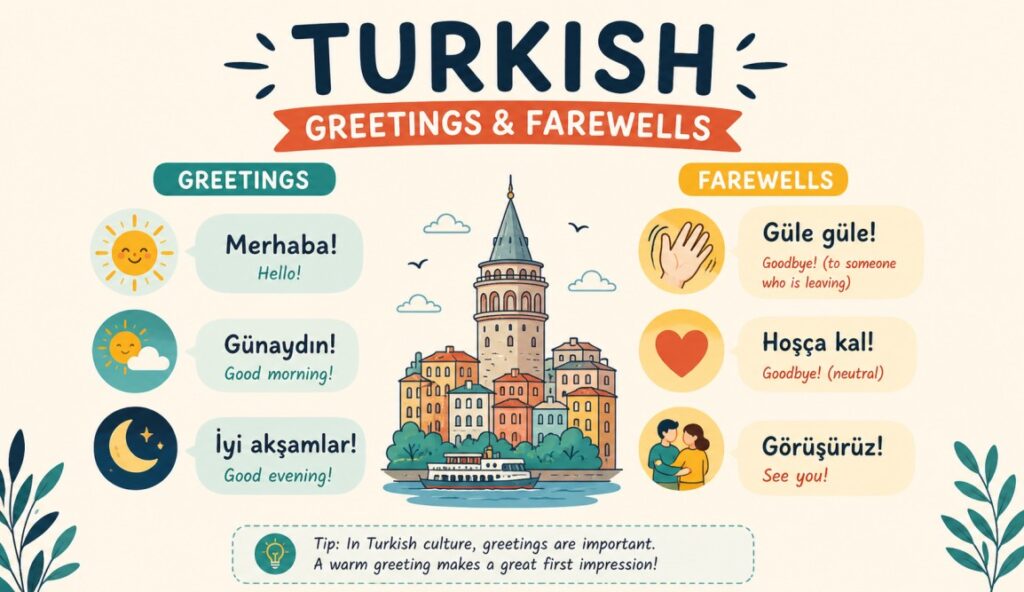
Learning a few Turkish greetings can transform an everyday exchange into a warmer, more respectful conversation. Merhaba is the safest all-purpose way to say hello, while selam is more informal. When it is time to leave, Turkish makes an interesting distinction: the person leaving says hoşça kal or hoşça kalın, and the person staying replies güle güle.
Quick guide to the most useful Turkish greetings
| Turkish | English | When to use it |
|---|---|---|
| Merhaba | Hello | Neutral and suitable in most situations |
| Selam | Hi | Informal; best with friends and people you know |
| Günaydın | Good morning | In the morning |
| İyi günler | Good day | A polite daytime greeting or farewell |
| İyi akşamlar | Good evening | From late afternoon or evening |
| İyi geceler | Good night | Late at night or before going to bed |
How to say hello in Turkish
Merhaba: the universal choice
Merhaba means “hello” and works in shops, hotels, workplaces and social situations. If you are unsure which greeting to choose, this is usually the most reliable option.
Selam: an informal hello
Selam is closer to “hi”. It sounds relaxed and natural between friends, colleagues who know one another well and people of a similar age. In a formal first meeting, merhaba is generally more appropriate.
Selamün aleyküm: a traditional greeting
Selamün aleyküm means “peace be upon you”. It has religious and traditional associations and is common in some families and communities. The usual response is aleyküm selam. As a visitor or beginner, you do not need to use it unless it suits the setting; merhaba remains perfectly polite.
How to ask “How are you?”
After greeting someone, you can continue with one of these phrases:
- Nasılsın? — How are you? (informal, singular)
- Nasılsınız? — How are you? (formal or plural)
- İyiyim, teşekkür ederim. — I’m well, thank you.
- Ya sen? — And you? (informal)
- Ya siz? — And you? (formal or plural)
Turkish distinguishes between informal and polite forms. Using -siniz, as in nasılsınız, is a respectful choice with someone you have just met, an older person or a professional contact.
How to say goodbye in Turkish
If you are leaving
- Hoşça kal — Goodbye; literally, “stay well” (informal, singular).
- Hoşça kalın — Goodbye (formal or plural).
If you are staying
Güle güle is said by the person who remains behind to the person who is leaving. This difference is one of the most useful pieces of Turkish etiquette for learners to remember.
Flexible ways to say “see you”
- Görüşürüz — See you.
- Görüşmek üzere — See you soon / Until we meet again.
- Sonra görüşürüz — See you later.
- Kendine iyi bak — Take care (informal).
- Kendinize iyi bakın — Take care (formal or plural).
Useful Turkish expressions in shops and workplaces
Kolay gelsin is a characteristically Turkish expression used when someone is working. Its literal meaning is roughly “may it come easily”, but in everyday English it is closer to “hope the work goes well”. You may hear it when entering or leaving a shop, office or workplace.
- Memnun oldum. — Nice to meet you.
- Teşekkür ederim. — Thank you.
- Rica ederim. — You’re welcome.
- Buyurun. — Please / Here you are / Go ahead, depending on context.
Turkish greeting etiquette
Greetings are an important part of Turkish hospitality. A handshake is common in professional settings. Friends and relatives may greet one another with cheek kisses, while younger people may show respect to an older relative by kissing their hand and briefly touching it to the forehead. Customs vary between families, regions and individuals, so it is sensible to follow the other person’s lead.
In formal situations, begin with merhaba or a time-specific greeting and use the polite form nasılsınız?. A friendly tone and a little patience matter more than perfect pronunciation.
Short example conversations
Meeting someone for the first time
A: Merhaba. Nasılsınız?
B: Merhaba. İyiyim, teşekkür ederim. Ya siz?
A: Ben de iyiyim. Memnun oldum.
B: Ben de memnun oldum.
Leaving a shop
Customer: Teşekkür ederim. Hoşça kalın.
Shopkeeper: Güle güle.
Leaving a friend
A: Görüşürüz. Kendine iyi bak.
B: Sen de. Güle güle!
Common questions about Turkish greetings
What is the safest way to say hello in Turkish?
Merhaba is appropriate in almost every everyday or professional situation.
Can I use “selam” in a business meeting?
It may be natural between colleagues who already know each other, but merhaba or günaydın is a safer choice for a first or formal meeting.
What is the difference between “hoşça kal” and “güle güle”?
The person leaving says hoşça kal or hoşça kalın. The person who stays says güle güle to the person departing.
Is Turkish pronunciation difficult?
Turkish spelling is relatively consistent: once you learn the sounds represented by letters such as ç, ş, ğ, ı, ö and ü, reading words aloud becomes much more predictable.
Take your Turkish beyond greetings
Memorising phrases is a useful beginning, but regular speaking practice helps you choose the right level of formality and respond naturally. Talk and Chalk offers private Turkish lessons adapted to travel, conversation and professional needs. You can also check your current level with our Turkish proficiency test.
If you would like a tailored learning plan, contact Talk and Chalk to discuss online Turkish lessons with an experienced teacher.
