
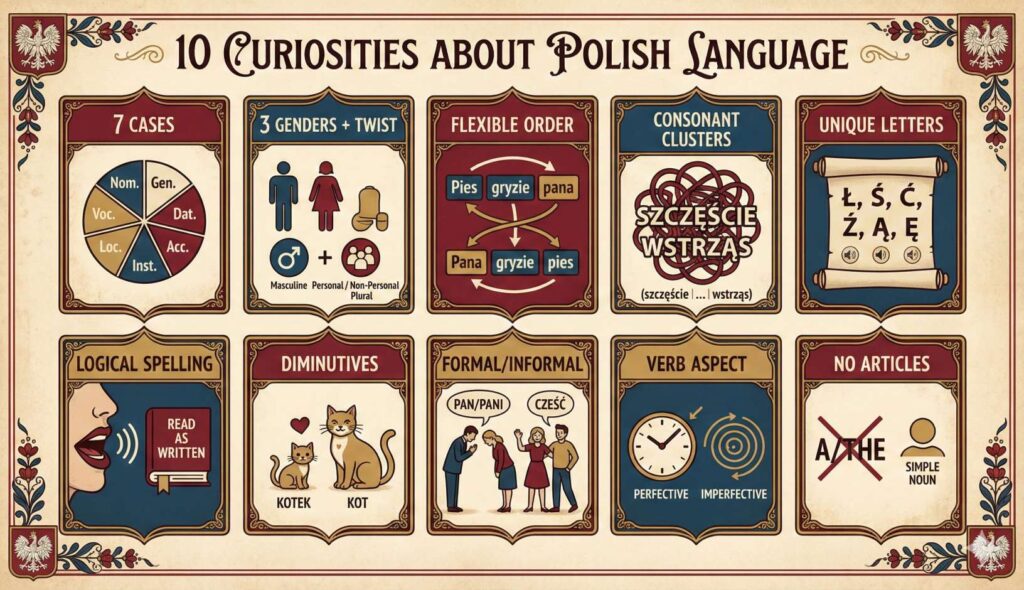
10 Curiosities About the Polish Language
Polish is one of Europe’s most fascinating and distinctive languages. Spoken by more than 40 million people, it is the official language of Poland and one of the most widely spoken Slavic languages in the European Union. At first glance, Polish may look complex or even intimidating, but behind that first impression lies a language that is logical, expressive, and full of cultural richness. 10 Curiosities About the Polish Language
If you are considering learning Polish — for work, family, travel, or personal interest — understanding its unique characteristics can make the journey much more exciting. Here are 10 curiosities about the Polish language that show why it stands out.
1. Polish Has Seven Grammatical Cases
One of the most distinctive features of Polish grammar is its system of seven grammatical cases. Instead of relying mostly on word order (like English does), Polish changes the endings of nouns, pronouns, and adjectives to show their role in the sentence.
For example, the ending of a word can tell you whether something is the subject, the object, a destination, a possession, or a tool used to do something. This system allows Polish to express meaning very precisely. Although it requires practice, cases also give learners flexibility and help them understand how sentences really work.
2. It Has Three Genders — With an Extra Twist
Like many European languages, Polish has three grammatical genders: masculine, feminine, and neuter. However, Polish adds an extra layer that surprises many learners.
In the plural form, Polish distinguishes between masculine personal (groups that include at least one man) and non-masculine personal groups (women, objects, animals, or mixed groups without men). This difference affects adjectives, verbs, and pronouns. It reflects how deeply grammar and meaning are connected in Polish.
3. Word Order Is Flexible and Expressive
In English, word order usually determines meaning: “The dog bit the man” is very different from “The man bit the dog.” In Polish, grammatical endings already show who does what, so word order can be changed to highlight different parts of the sentence. 10 Curiosities About the Polish Language
This flexibility allows speakers to add emphasis, emotion, or stylistic nuance. For learners, this means Polish is not just structured — it’s also expressive and creative.
4. Polish Is Famous for Its Consonant Clusters
Polish is well known for words filled with consonants, such as Szczęście (happiness) or Wstrząs (shock). To English speakers, these may look impossible to pronounce, but they actually follow consistent phonetic rules.
Once you learn how Polish sounds combine, these words become manageable. Mastering them is a big milestone for learners and often a moment of pride — suddenly, the “impossible” language starts to feel natural.
5. Unique Letters Create Unique Sounds
The Polish alphabet uses the Latin script but includes several additional letters with diacritical marks, such as Ł, Ś, Ć, Ź, Ż, Ą, and Ę. Each of these represents a specific sound that doesn’t exist in English.
For example, Ł sounds like an English “w,” while Ś and Ć are soft consonant sounds. The nasal vowels Ą and Ę add another distinctive feature. These letters may seem unusual at first, but they help make Polish pronunciation precise and consistent.
